

You Are Not a Machine
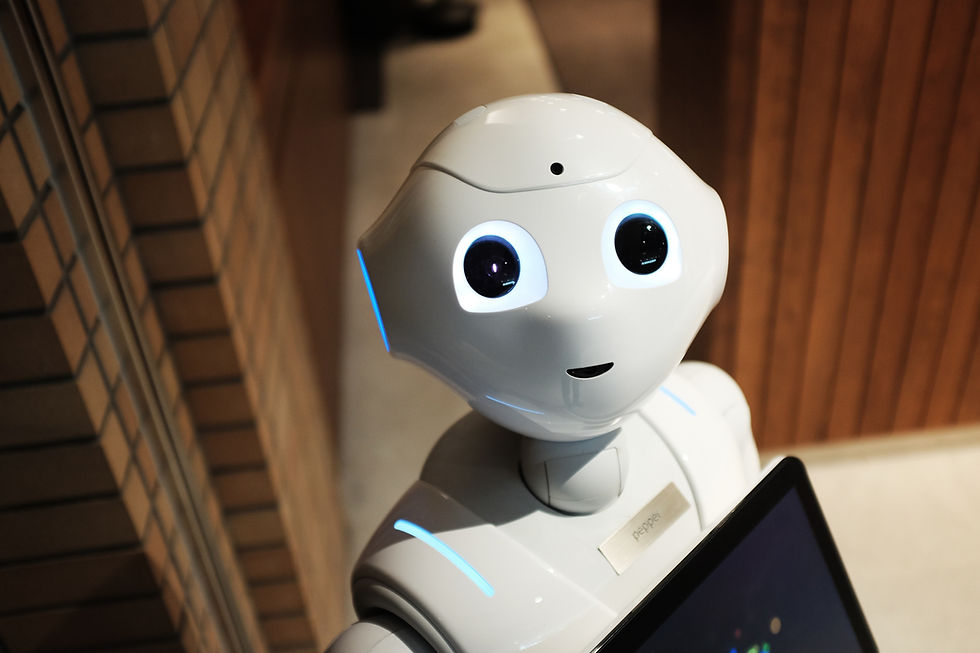
I have been reading and listening a lot lately about AI and its impending expansion into society at large. I have listened to many of the pros and cons concerning this certain development coming our way. The overwhelming pro put forth is that people, students in particular, will have an all-benevolent and all-patient tutor/helper/assistant at their disposal. The creepy part of that to me is that we are quite literally creating an idol here. We already have a God who is all-benevolent, all-patient, all-kind, all-loving, and all-good. He goes by "I AM" lest we be confused.
One of my favorite Hebrew words to study is "chesed." There is no English equivalent for this word, so Miles Coverdale made up a word called "lovingkindness" to do some justice to the meaning in his English translation of the Bible. Many of the 190 references to chesed in the Bible do not list God as the only participant. The language is covenantal and dependent upon the loyalty of the Israelites. N.H. Snaith writes that "the theological importance of the word chesed is that it stands more than any other word for the attitude which both parties to a covenant ought to maintain towards each other." There is an expectation of our righteousness in our covenant with God. Romans 6:1-2 echoes this reality in saying, "What shall we say, then? Shall we go on sinning so that grace may increase? By no means! We are those who have died to sin; how can we live in it any longer?"
God always shows mercy over judgment, but we still have responsibility in our relationship with our Creator. Snaith concludes that God's "demand for righteousness is insistent, and it is always at the maximum intensity. The loving-kindness of God means that his mercy is greater even than that. The word stands for the wonder of his unfailing love for the people of his choice, and the solving of the problem of the relation between his righteousness and his loving-kindness passes beyond human comprehension." Our desire to create AI to become some benevolent partner to us will always fail because it is not God. I wonder if we are asking why we feel the need to develop such technology? As the Tower of Babel builders discovered, just because you CAN do something, doesn't mean you SHOULD.
Although proponents of using AI elaborate on the co-relationship we will enjoy with it, I have my doubts. My concern with this god we are creating is the potential for us to slip into culture-wide apathy. I am bothered by the lack of critical thinking already becoming rampant in our time and I do have concern that the explosion of AI is going to breed indolence in us. We already use the internet for easy access to information--whether it is reliable or not. When AI can take on tasks and begin thinking for us, where will our initiative to create, wonder, explore, and collaborate go? I have serious visions of "Wall-E" in mind. This is no covenant and I see no accountability on the horizon.
We have already exchanged words for abbreviations, textbooks for Chromebooks, and are becoming less and less literate by the year. This article by Steven Mintz, a professor from UT Austin, addresses some of those literacy statistics and also some myths. Because our reading now occurs in short bursts and abbreviated forms, he finds:
The likely result: an increase in distractibility. It seems plausible that attention spans have diminished and that most people’s ability to concentrate for prolonged periods of time has declined. Inattention may well have increased, as we are more easily diverted. ~Mintz
I also found this podcast very interesting to consider what our culture looks like as it becomes less traditionally literate: "Why Americans Read Less (& Why We Should Care More)."
The whole reason I felt called to go to seminary six years ago was because of the overwhelming lack of Biblical literacy I saw around me. I realized, though, as I taught in the church and with students that there is now a need for educators and pastors to become increasingly more "engaging," which really just means entertaining. There is a constant need to be as visual and abbreviated as possible when educating others. Perhaps AI is going to come in handy for that? Goodness knows I would hand over my Google Slide creations to AI if I could. I have my doubts when it comes to authenticity, though. AI can certainly write a sermon or create a painting or compose a piece of music (based on prior human genius, by the way), but it will lack all of the human depth and emotion necessary to connect with people.
I realize that there will be areas of increased accuracy and maybe even perfection in important parts of some fields with the addition of AI. In opposition to the apathy problem, however, I also wonder what this is going to do to our perception of human performance? I, for one, already struggle with workaholic perfectionism and have to remind myself daily that I will actually never get everything done or achieve what is perceived to be enough. If performance rubrics are now being generated by and based on the outcomes of machines, will we not expect one another to perform at never-resting machine-like standards?
Everyone thought that the information age would bring more leisure time to Americans. The plan was for all our modern-day conveniences to allow us more free time to live, play, and enjoy one another's company. That was not at all the outcome. People--myself included--work longer than ever hours now that work can be done any minute from anywhere. I do not find new technology something to be feared, but it is also not something to be ignored. From a stance of curiosity rather than trepidation, it will be interesting to see what comes of the AI generation.
I am writing about this as I just finished listening to a sermon on the importance of daily time spent with God. We are all so (proudly) busy all the time that carving out a few precious moments with the God who made us and wants to show us the path to life abundant seems impossibly hard to fit in. I am now more than ever convinced that these precious moments + Sabbath-keeping need to become a rhythm we establish now ***BEFORE*** our world embarks on yet another "age" where we are in a daily race with computers to learn more and become even more proficient in all that we are. I am certain I will need the constant reminder, "You are NOT a machine." Part of our dependence on God comes from this very important realization. We were created to need one another and work in covenant relationship with the One true intelligence. We do not need artificial intelligence for anything when the omniscient God is at our side every second of the day.
References and Resources:
Articles:
Podcasts:
https://www.jordanbpeterson.com/podcast/ai-the-beast-or-jerusalem-jonathan-pageau-jim-keller-ep-308/


Comments